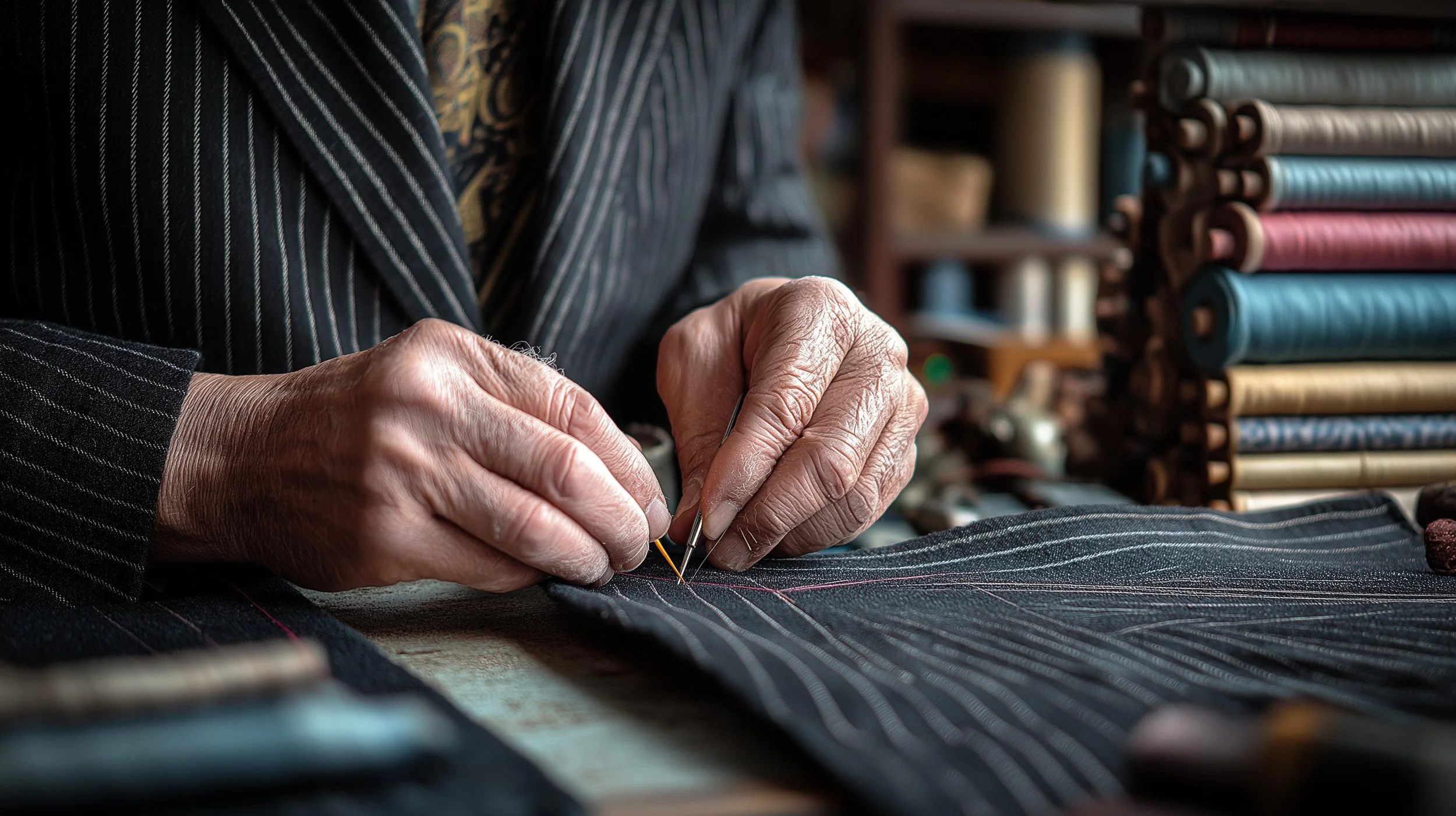
The Mark of the Maker
There's a particular quality to something made by hand with intention. You can feel it in a well-built piece of furniture, a hand-thrown ceramic, a letterpress print. You can also feel it in a logo. Not because of any technical trick, but because the decisions that shaped it came from a place of understanding that no dataset can replicate.
We're living in a moment where anyone can generate a logo in thirty seconds. Type a prompt, pick a style, download a file. The output is often competent. Sometimes it's even attractive. But competent and attractive are not the same as meaningful, and meaningful is what separates a brand mark from a decoration.
What a Logo Is Actually Doing
A logo isn't art. It's not self-expression. It's a functional object with a very specific job: to serve as the most compressed expression of a brand's identity. It carries meaning in a fraction of a second. It works at the size of a favicon and on the side of a building. It communicates to people who have never heard of you and reminds people who already love you why they do.
That's an extraordinary amount of work for a single mark to do. And it can only do that work if every line, every curve, every proportion, every negative space was placed there for a reason. Not a stylistic reason. A strategic one.
The best logos in the world aren't the most elaborate. They're the most intentional. Every element exists because it earned its place through a process of refinement that only happens when a designer deeply understands the brand they're designing for.
The Conversation That Changes Everything
Here is the part that AI cannot do: the conversation. The back-and-forth between a designer and a founder where the real brand reveals itself. The moment when a client says something offhand about why they started their company and the designer recognizes it as the emotional core of the entire brand.
These conversations are messy, nonlinear, and profoundly human. They involve reading body language, hearing what's not being said, pushing back on assumptions, and asking the uncomfortable questions that lead to breakthrough clarity. A prompt field doesn't do this. It can't.
The designer who sits across from you and listens, who challenges your first instinct, who brings their own creative intelligence to bear on your problem, that person is not a production tool. They're a strategic partner. And the mark they create is infused with the understanding that only comes from that partnership.
The Craft Itself
There's a technical dimension to logo design that gets lost in the AI conversation. Optical balance, where a circle needs to be slightly larger than a square to appear the same size. The way a letterform's weight needs to be adjusted at small scales. The relationship between positive and negative space that creates visual tension. The difference between mathematical centering and perceptual centering.
These are not things you learn from a tutorial. They're developed over years of practice, study, and refinement. A skilled logo designer makes hundreds of micro-decisions that are invisible to the untrained eye but collectively determine whether a mark feels right or feels off.
AI can approximate the surface of good design. It can produce output that looks like a logo. But it cannot make these decisions because it doesn't understand why they matter. It's pattern-matching against existing work, not reasoning about the specific needs of a specific brand.
The Averaging Problem
Generative AI works by finding the statistical middle ground of its training data. It produces the most probable output given a set of inputs. This is, by definition, average. It's the visual equivalent of a committee decision, a synthesis of everything that already exists, smoothed into something inoffensive and familiar.
But the logos that define brands aren't average. They're specific. They're sometimes strange. They make choices that a committee would have argued against. The Nike swoosh is just a checkmark. The Apple logo has a bite taken out of it for no functional reason. The FedEx arrow is hidden in plain sight. These marks work because they're distinctive, and distinction is the opposite of averaging.
When you generate a logo with AI, you get the center of the bell curve. When you work with a designer, you get something that could only exist for you. That specificity is what makes a logo memorable, and memorable is the entire point.
What You Lose Without Knowing It
The danger of AI-generated logos isn't that they look bad. It's that they look fine. Fine enough to use. Fine enough that you don't realize what you're missing until years later, when your brand feels generic and you can't figure out why.
What you lose is the story. A bespoke logo carries the narrative of its creation, the strategic thinking that shaped it, the intentional choices that connect it to your brand's deeper identity. When someone asks about your logo, you have something to say. When your team looks at it, they see the values and positioning that informed it. It becomes a touchstone, not just a graphic.
An AI-generated mark carries no story. It carries no intention. It's a visual placeholder where a brand asset should be. And over time, that absence of meaning becomes a ceiling on how far your brand can grow.
A Defense of the Investment
Bespoke logo design is expensive relative to the alternatives. That's true. But the alternatives are free or cheap precisely because they skip everything that makes a logo valuable. They skip the strategy. They skip the conversation. They skip the craft. They skip the specificity.
The investment in a custom logo is not a cost of doing business. It's a strategic decision to build your brand on a foundation that is uniquely, irreplaceably yours. It's the decision to show up in the market with a mark that communicates at every touchpoint that you take your business seriously, that you've thought deeply about who you are, and that you've invested in presenting that identity with care.
That signal matters. Your best prospects notice it. Your competitors notice it. Your team notices it. And over the lifetime of your brand, the return on that investment compounds in ways that are impossible to calculate but unmistakable to experience.
The Thing Machines Cannot Do
Machines can generate. They cannot understand. They can produce output that resembles meaning. They cannot create meaning. And a logo without meaning is just a shape.
The value of bespoke design has never been about the deliverable. It's about the thinking that produces the deliverable. It's about a human being who cares about your brand engaging their full creative intelligence to solve a specific visual problem in a way that no one else would solve it.
That's not a luxury. In an age where anyone can generate a passable logo in seconds, it's the only real competitive advantage left. The brands that invest in human craft will stand apart from the ones that took the shortcut. Not because the shortcut produces bad work. But because it produces the same work for everyone. And sameness is the one thing a brand cannot survive.